
Before and after
That is about 16 times the daily pace, and more than double the owner's goal.
Online orders since I started
Each bar is the average number of online orders a day in that month. Tan bars are before I started in March 2026. The last bar is November 1 to 7 only.
What I did, in order
- Audit everything I mapped the whole stack first: the ecommerce platform, product data, Google Ads, the Merchant Center feed and the tracking. That told me what I could fix, what needed the vendor, and the order to do it in.
- Rebuild the product data I rewrote titles, descriptions and categories on 2,045 product pages, in batches. I checked each batch against the store's own back office before calling it done.
- Clear the Merchant Center flag An account flag had the whole catalog switched off in Google Shopping. I fixed the policy problems behind it and got the business verified. The flag cleared in June.
- Turn on the free listings With the catalog allowed back in, free Google Shopping listings started earning clicks. No ad spend. From the September 8 launch to October 25, about 45% of online orders came this way.
- Move the store to Shopify The registers went live on August 31, 2026 and the new website on September 8. October is the first full month on it.
- Check the numbers I compared the pages I rebuilt against the rest of the site, and each batch against the other. The lift showed up only on the rebuilt pages, after each push.
The Google numbers
Before the orders came the visibility. These two charts compare the same two 28-day windows in Search Console, March 24 to April 20 and August 3 to 30, 2026.
More Google charts
Where these numbers come from. Order counts come from the store's own order records, and search figures from its Google Search Console. Free-listing clicks come from Google Merchant Center. Search Console data for this store starts March 24, 2026, so growth figures compare two equal 28-day windows, not a full year. The store does not publish its revenue, so this page shows order counts.

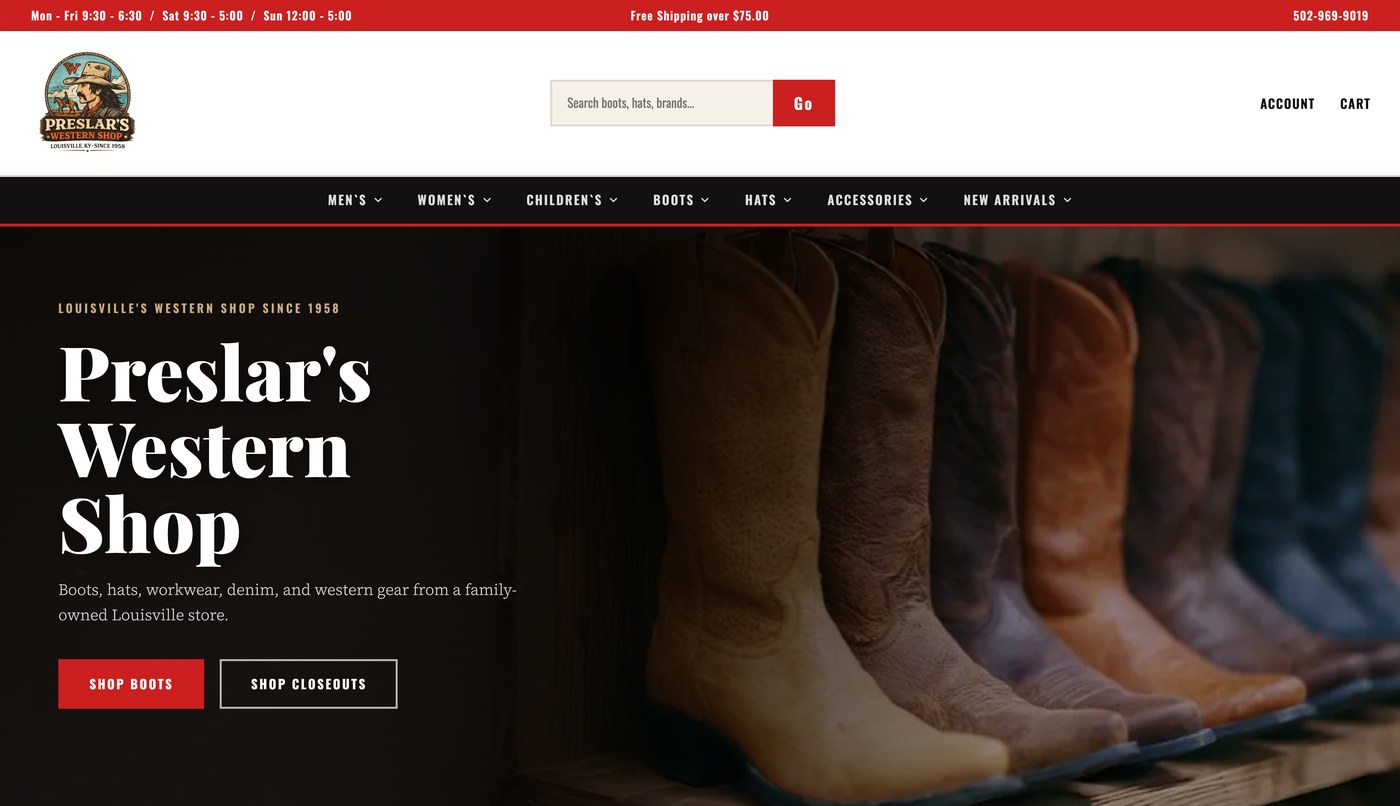
Go see the store for yourself.
Boots, hats, workwear, and denim from a family-owned Louisville shop that's been at it since 1958.
The pattern this fits
This is the local retail and ecommerce cleanup pattern. It works the same way for boutiques, specialty retailers, and inventory-heavy local stores on older platforms. Anywhere the products, the ads, or the tracking have nobody really owning them.
If the catalog side isn't your problem and you just need to be found, that's the smaller version of the same work. It lives on the Louisville SEO company page.
If the storefront is solid but the online side feels messy, this is what fixing it looks like.